
Stock Characters We Inherit, and What to Do With Them
On the history behind familiar types, from the gay best friend to the final girl, and why it's important to constantly revise our thinking

This is the fourth post in a series on writing across difference, drawn from a lecture I gave to the University of Nebraska Omaha MFA program. It builds on Writing Across Difference Is Just Writing Well, Research Starts With You, and Question the Story You Know, but it stands on its own too. Catch up if you haven't already.
It’s impossible to fully develop every character who walks onto a story’s stage. Fiction often depends on minor or functional characters—and sometimes on recognizable stock types—to advance the plot, keep the momentum going, add texture to a setting, and support the main characters. All writers use them. Stock characters are types repeated across literature for so long that they’ve become shorthand: the reader recognizes the role instantly, and the story doesn’t have to stop and explain.
That shorthand has a history, though, and that history can be problematic. Literary tradition is full of stock characters shaped by whatever the dominant narrative happened to be in a given period, and plenty of those types haven’t been shaken off, more out of habit than intention. That doesn’t mean every stock character is defined by a negative stereotype, but it does mean we need to bring a critical eye to the stock characters we lean on and revise our thinking.
Imagine three broad categories. In one, you’ve got relatively low-risk shorthand: the family doctor who delivers a diagnosis, the secretary who guards the door, the small-town sheriff who shows up to advance the plot. Even these figures can carry assumptions about gender, race, class, and power, but their primary function is usually narrative rather than ideological. They play a role, then step aside.
In the second category are types built more obviously on stereotype than on function. Some are plainly offensive. The tragic mulatta or mulatto emerged as a recurring figure in nineteenth-century American fiction: a mixed-race character whose ancestry leaves them vulnerable to enslavement or a catastrophic loss of social position. The trope often ends in ruin or death. In some works, racial mixing itself is treated as the tragedy. In abolitionist fiction, the figure could also be used to expose the cruelty and absurdity of slavery and the racial order, but even then, the character was often made more sympathetic to white readers by being light-skinned and, in their minds, closer to whiteness.
The “Yellow Peril” villain turns racial difference into threat rather than pity. Its most notorious embodiment is Sax Rohmer’s Fu Manchu, introduced in magazine stories in 1912 and collected in a novel the following year: a mastermind whose foreignness is presented as evidence of menace, whose intelligence becomes sinister cunning, and whose ambitions are filtered through the assumption that the Asian outsider threatens the West.
Dressing a stereotype up as a compliment doesn’t keep it from reinforcing assumptions that further marginalize already marginalized characters.
Other stereotypes are sneakier. They flatter rather than demean, which makes them harder to catch. The “Magical Negro” is often beloved within the story: wise, patient, gifted with an almost mystical understanding of exactly what the white protagonist needs to learn. He receives warmth, gratitude, sometimes even reverence. What he rarely receives is a story of his own. Spike Lee popularized the term in 2001, naming a pattern that had been running through Hollywood for decades, one that echoes older stereotypes—the mammy, the happy slave, the selfless servant—created to serve white characters’ material and emotional needs. Ask what life Bagger Vance has beyond restoring Junuh’s swing, or what possibilities The Green Mile imagines for John Coffey beyond healing others and accepting death, and the answer is, well, not much. They often function as symbols, not characters, and their gifts exist principally to move someone else’s arc forward.
The gay best friend often runs on a similar mechanism, relocated to a different kind of story. The type became especially prominent in the romantic comedies and television shows of the 1990s and 2000s, a way to include a gay character while keeping him safely outside the central romance. He’s stylish, witty, endlessly supportive, sharper about relationships than anyone else in the room, and all of that reads as flattering on the surface. But the flattery is the trap, as it is with the Magical Negro. Neither character is admired for being fully human. Each is admired for performing a role, and that role exists to help someone else, usually the story’s actual protagonist, along her arc. Dressing a stereotype up as a compliment doesn’t keep it from reinforcing assumptions that further marginalize already marginalized characters.
The fix isn’t complicated: give him goals, relationships, conflicts, and something to lose that have nothing to do with the person he’s there to help.
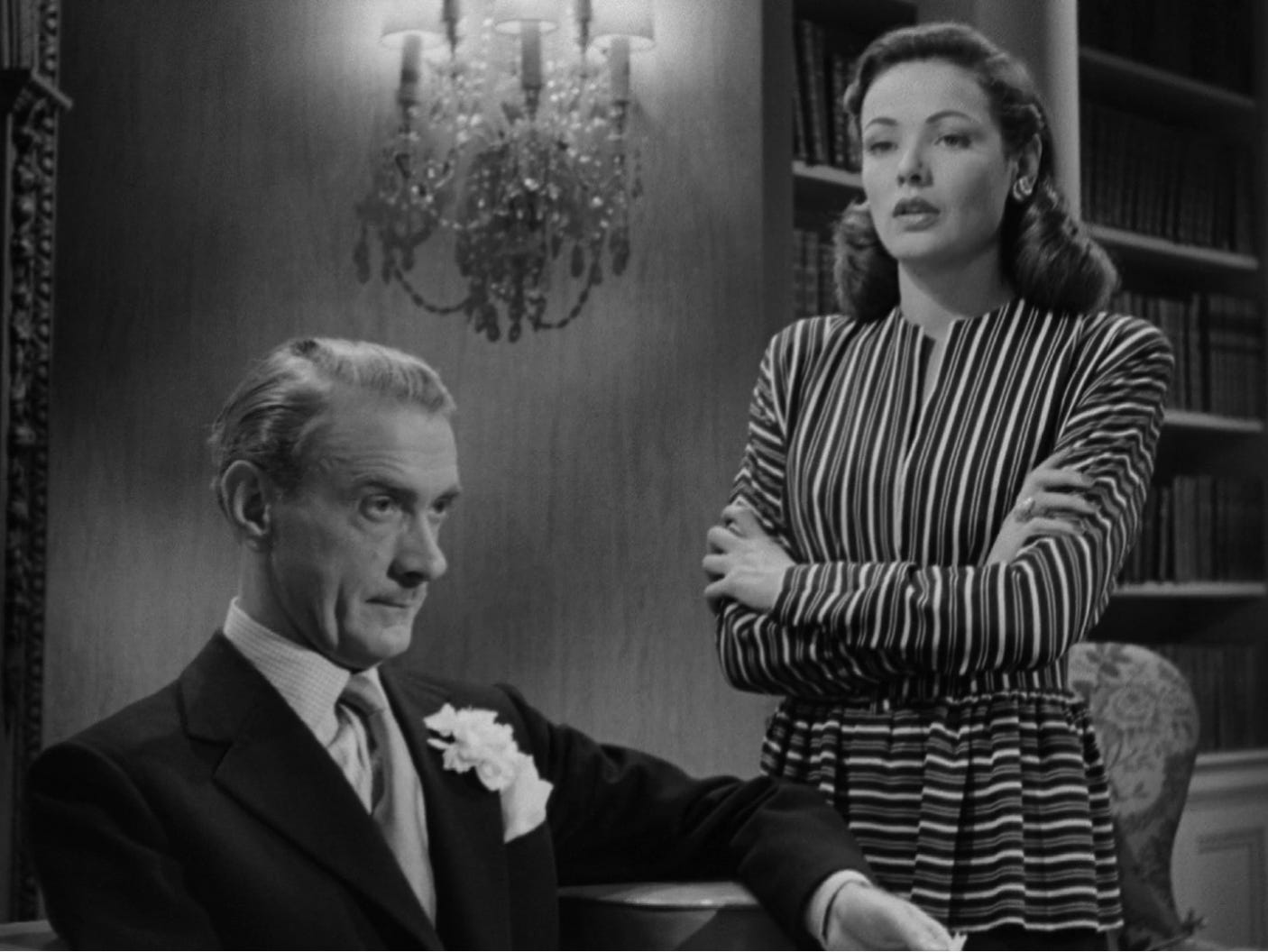
The third category is the harder one: types that can go either way depending on whether the writer understands what they’ve inherited. The final girl is a clear example.
Psycho offered an important precursor, but the figure emerged more recognizably in 1970s films such as The Texas Chain Saw Massacre and Black Christmas before Halloween codified an enormously influential version of the type in 1978. Laurie Strode is sexually inexperienced, responsible, and resourceful; meanwhile, the friends who neglect their surroundings while pursuing sex are killed.
Whatever John Carpenter and Debra Hill intended—and both rejected the idea that they were deliberately writing a sexual morality play—the pattern hardened across the slasher boom into a familiar equation: the sexually available girl dies, while the restrained and vigilant girl survives. Once repeated often enough, the pattern begins to look less like coincidence and more like a moral argument: purity survives, sexual desire gets punished.
That’s not just shorthand. It’s a kind of patriarchal double standard dressed up as plot structure, inherited from older, fairly Victorian ideas about what makes a woman worthy of survival.
But the type didn’t stay fixed. Sidney in Scream has sex and survives. Jay in It Follows is sexually active and, like Laurie Strode, responsible, resourceful, and physically resilient, although the film complicates the issue by making sex both a source of danger and a possible means of survival. These films preserve the role of the final girl while challenging the assumptions that had become attached to her.
Where stereotypes flatten stock characters and reduce them, if not outright degrade them, archetypes can give writers a broader pattern of desire, fear, or conflict from which to begin. The distinction is not absolute. An archetype can harden into stereotype when it is applied rigidly. Still, used with care, an archetype can help a writer give a functional character an internal tension that does not depend on social assumptions.
The familiar twelve-archetype system—including figures such as the Lover, Explorer, and Creator—was developed by Carol S. Pearson from Carl Jung’s influential theory of archetypes: recurring patterns and images associated with what he called the collective unconscious.
For writers, such systems can provide provisional patterns of desire and conflict. A Lover may be guided by intimacy but risk losing a sense of self. An Explorer may crave freedom but struggle to commit. A Creator may be visionary but perfectionistic or impractical. For every central desire, there is an emotional obstacle built in. That pairing is what makes an archetype useful rather than merely reductive.
Think of it as a skeleton, not a finished character.
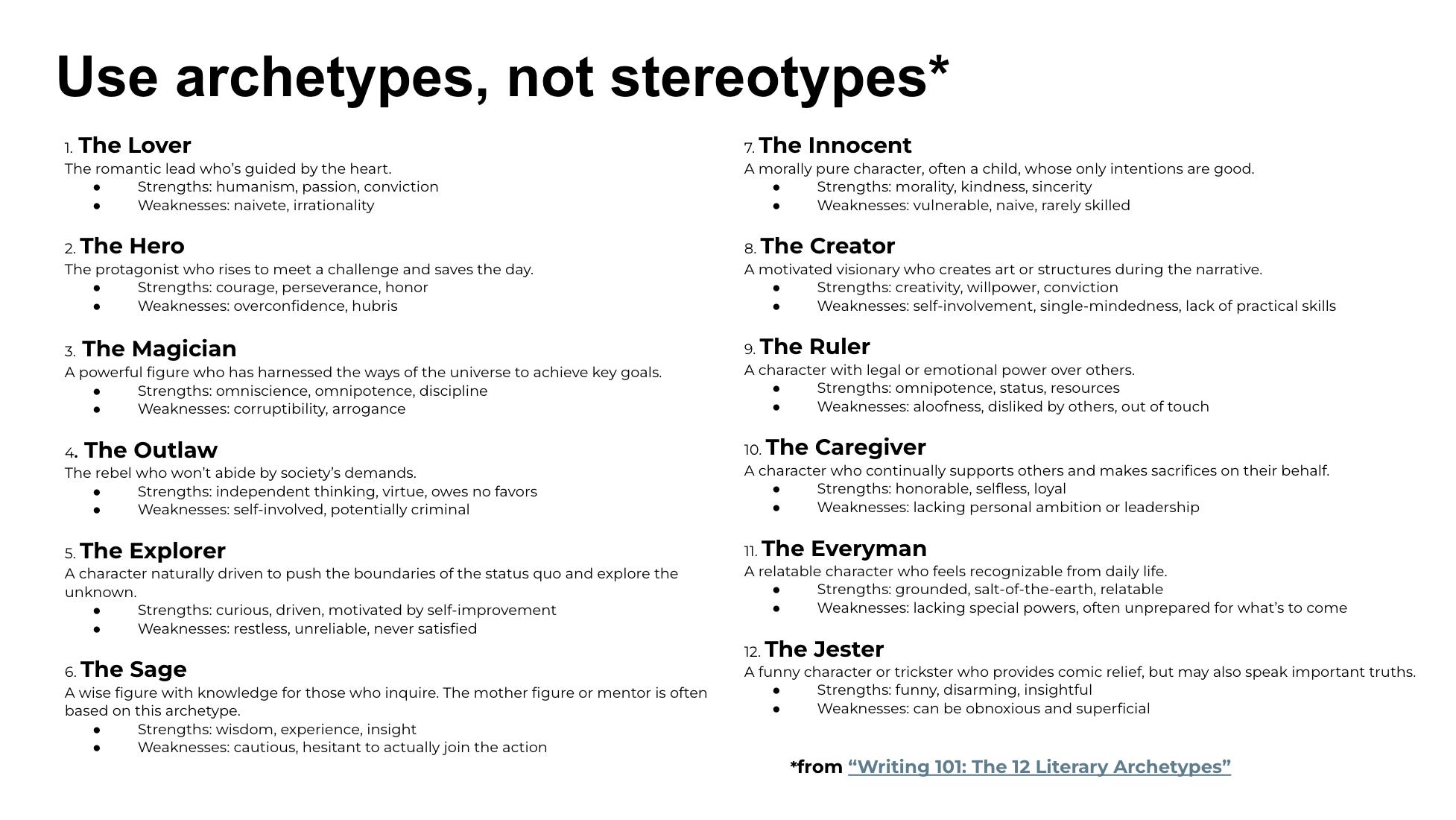
Where a stereotype assigns supposedly fixed characteristics to members of a social group and reduces a character to a single use, whether degrading or flattering them, an archetype provides a broader narrative pattern that can be used to develop either a stock character or a main character. It remains the writer's responsibility to decide how far to flesh out that skeleton and what choices of characterization to make along the way.
The gay best friend can go through the same rebuild as the final girl. Stop constructing him from an idealized surface and start with desire, fear, conflict, and contradiction instead. Write against the type. Suddenly he gives terrible relationship advice, loathes brunch and mimosas, and tells the worst dad jokes. Imagine! His being gay becomes a fact about him rather than a role he performs.
The third post in this series talked about the dominant narrative, the default story a culture already tells about a kind of person, and the counternarrative you write to complicate it. The same move applies here, just at a smaller scale, and it applies whether you’re building a lead or someone who’s on the page for a single scene: learn the history of the type you’re using, and find a way to complicate it.
With all this in mind, next week we’ll focus on modes of characterization: how we see, hear, and inhabit a character on the page.
Pre-order here!

Really great, John! What good reminders to help us stay on our toes -- so easy not to.
Reading this, I had a major epiphany about a character in my WIP! As always, John, thank you for challenging all of us to do better, try harder, and give our characters the chance to be as real as they can be.
Side note: did you ever see "Are You Being Served?", that old '70s British sitcom about the staff in a department store? I wouldn't really recommend it... it includes all the sexism, ageism, and racism of the era. BUT the lone gay character, Mr. Humphries, is brilliant. Of course he's written as a stereotype: fey, flamboyant, impish, lives with his mother. Mr. Humphries transcends it all to become the undeniable star of the show, and now you've got me trying to figure out how. I think it's because:
a) he's almost never the butt of anyone's joke. He's the most competent salesperson on the floor, and the other characters like and respect him.
b) he has a fascinating (hidden) life. The other characters bitch and bicker about their low-budget London lives, while Mr. Humphries always seems to be having a tremendously good time on- and off-camera, from the little hints he drops (and the wild costumes he occasionally shows up in.)
Long digression aside -- thank you for this excellent edition of TTP, please keep them coming!